


Why Handmade Tiles Beat Mass-Produced Every Time
Choosing tiles for a contemporary kitchen can be hard to get right, but it's all part of the journey to creating the best kitchen for your home. The options are vast, the price points are confusing and the consequences of a poor choice follow you for years. This guide helps you understand what makes handmade kitchen tiles worth choosing, what to look for when you do, and what to avoid.
- What specific features should you look for when choosing handmade tiles for a contemporary kitchen?
- Handmade versus mass-produced kitchen tiles: what do the comparisons tell you?
- Which types of handmade tile are best for different areas in a contemporary kitchen?
- What are the most useful alternatives to handmade tiles if they're not right for your kitchen?
- How can you avoid common mistakes when choosing handmade tiles?
- Explore Further
What specific features should you look for when choosing handmade tiles for a contemporary kitchen?
Not all tiles sold as handmade are made the same way. Some are genuinely formed by hand using traditional methods. Others carry the label loosely. Knowing what to look for means you can choose with real confidence.
Ask yourself these questions before you commit:
Does the tile have visible tonal variation? Genuine handmade tiles are never perfectly uniform. That individuality is what you're paying for.
Are the edges softly irregular? Hand-formed tiles don't have the sharp regularity of a machine-pressed piece. Slight variation is a mark of craft, not poor quality.
Can the maker, region or technique be named? Materials from artisans in Morocco or Spain carry traceable heritage. Vague claims of being 'artisan inspired' are worth probing.
Does the glaze have depth? In quality handmade tiles, the glaze varies in tone and surface character across each piece. In mass-produced tiles, it's a flat, even coat.
Has your supplier mentioned size variation? Handmade tiles vary slightly in dimension between pieces, which calls for a slightly wider grout joint. If no one's mentioned it, ask.
Is the tile rated for its application? Wall tiles can carry more decorative surface. Tiles for floors and heavily used areas need to meet specific performance requirements. Check the specification, not just the photograph.
Have you ordered samples? Handmade tiles look different at scale and in natural light. Sampling isn't optional. It's the most important step before you buy.
Handmade versus mass-produced kitchen tiles: what do the comparisons tell you?
Mass-produced tiles are made to exacting tolerances. Every tile is the same size, the same colour, the same surface. For some applications, that consistency is exactly what you need.
But in a contemporary kitchen, that uniformity can work against you. The room looks polished in photographs and oddly flat in everyday life. The surfaces feel as though they belong in a catalogue rather than a home that's actually lived in.
Handmade tiles behave differently. Whether it's a terracotta floor tile crafted near Murcia in Spain, a zellige tile individually moulded in Fez or a glazed ceramic shaped by an artisan maker, the variation between pieces is what creates depth. Light moves differently across an uneven glaze. Colours shift subtly from tile to tile. Grout joints become part of the composition. The result is a kitchen that reads as individual, because it is.
The result is a kitchen that reads as individual, because it is.
”On practical grounds, quality handmade tiles are also more forgiving over time. Their surfaces age naturally, developing what's often called patina, rather than showing wear as damage. A properly sealed terracotta tile deepens in colour and matures with use. The initial cost is higher. But for a surface you'll live with for decades, that's a reasonable trade.
Which types of handmade tile are best for different areas in a contemporary kitchen?
The contemporary kitchen covers a lot of ground: from warm, layered schemes in refurbished period homes to quieter finishes in open-plan new builds. Different handmade tile types suit different applications.

Zellige Tiles
Zellige tiles are well suited to kitchen splashbacks and feature walls. Each tile is individually moulded from a special blend of local clay in Fez, then fired, glazed and fired again. That process gives every piece its characteristic depth and surface variation: the tone, texture and irregularities are unique to each tile. On a splashback, particularly in tones like moss green, ochre or cornflower blue, the surface shifts with the light throughout the day.
Terracotta Floor Tiles
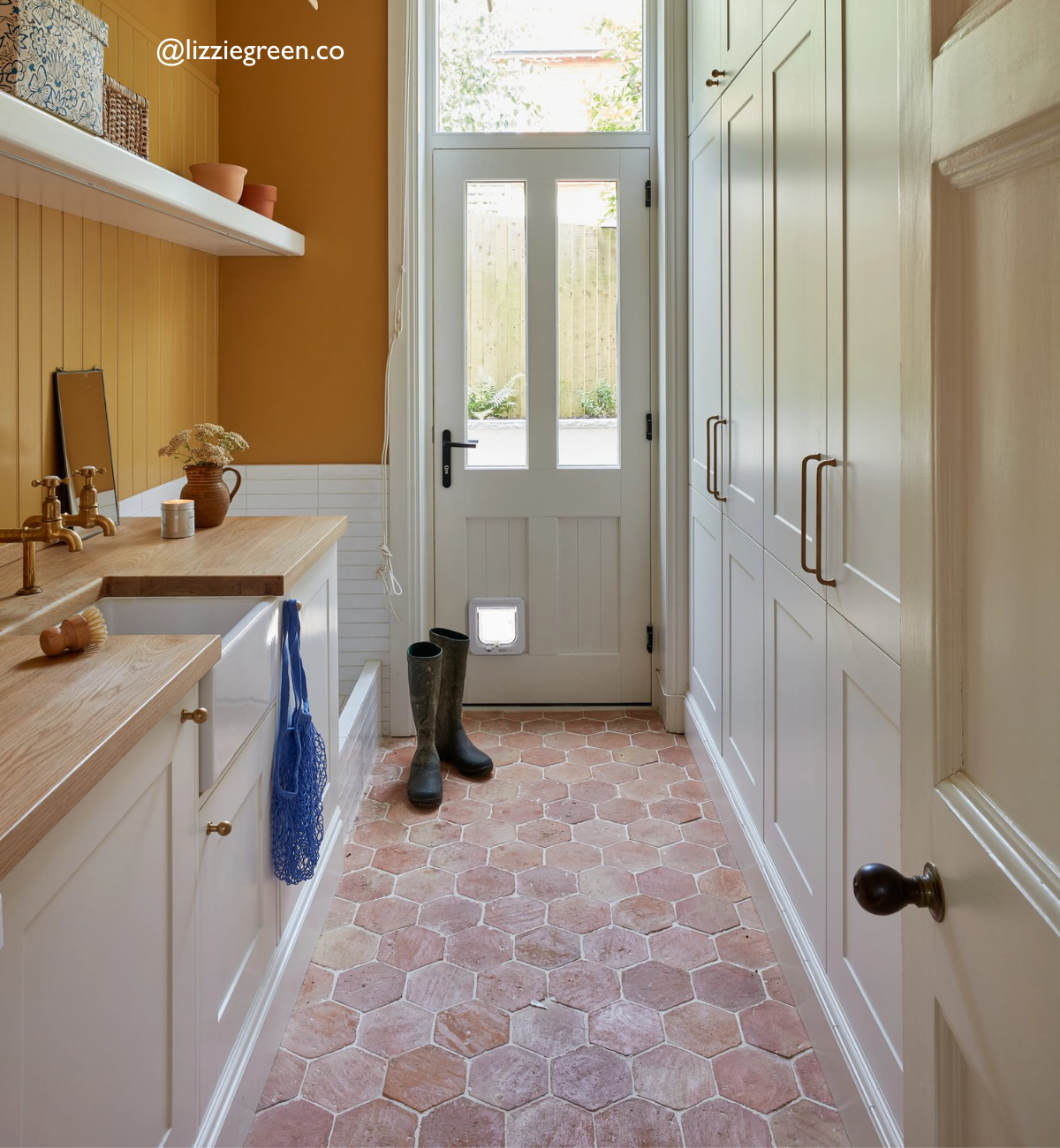
Terracotta floor tiles work well in kitchens where warmth matters more than a high-gloss finish. Our Handmade Classic terracotta is crafted in a traditional farmhouse near Murcia in Spain by a family business that has been producing tiles for over six generations. Exclusive to Fired Earth in the UK, the range brings imperfect edges, rustic texture and wide colour variation to every space. Tones range from gentle beiges and sandy yellows through to rich burnt oranges and deep reds. Once sealed, the colours intensify and gain further character. It pairs well with natural timber, stone or exposed brick.


What are the most useful alternatives to handmade tiles if they're not right for your kitchen?
Handmade tiles aren't the right choice for every kitchen. If the project demands very tight grout lines, perfectly consistent sizing or a completely flat wall finish, a machine-made tile will serve you better. And a well-chosen one can look just as considered.
Large-Format Porcelain
A natural alternative for kitchens built around calm, expansive surfaces. It offers consistent sizing and minimal grout joints, which suits schemes where the tile is a backdrop rather than a focal point.
Terrazzo Tiles
Sits somewhere in between. Made from a composite of stone chips set in a cement or resin base, terrazzo carries natural variation from the aggregate itself. It suits kitchens with clean lines and a modern palette.
Natural Stone
Limestone, slate and marble are each quarried and cut individually, which gives them some of the same visual interest as a handmade tile. They require sealing and some ongoing care, but they age well.
Hand-Painted Ceramic, Used Selectively
If you're drawn to the character of handmade tiles but working within a tighter budget, a splashback panel or a single accent row within a plainer field delivers much of the effect at lower cost.
How can you avoid common mistakes when choosing handmade tiles?
The gap between a confident choice and a costly one often comes down to a handful of details. Use this as a final check before you order.
| ✓ Green flags: signs of quality | ✗ Red flags: common selection mistakes |
|---|---|
| Visible tonal variation and surface depth across tiles in the same batch | Identical tiles throughout: no variation in colour, texture or finish |
| Softly uneven edges that show individual forming or hand finishing | Perfectly straight, sharp edges on every piece: a sign of machine pressing |
| A glazed or unglazed surface with texture you can feel, not just see | A surface that looks textured in photographs but feels flat to the touch |
| Named provenance: a maker, region or technique you can trace | Vague references to being 'artisan inspired' with no traceable origin |
| Clear guidance on grout joint width to accommodate natural size variation | One-size installation notes with no mention of variation |
| A supplier who recommends ordering extra to account for natural batch variation | A standard overage allowance with no acknowledgement of irregularity |
| Honest care and sealing advice specific to the material | Generic maintenance instructions that could apply to any ceramic |
Explore Further
Ready to Choose?
We've been sourcing authentic handmade tiles for more than 40 years, working directly with artisan makers, family-run quarries and specialist producers whose craft is traceable and whose materials are chosen for longevity as much as beauty. Every tile in our collection has been considered for how it will live, not just how it photographs. If you're ready to choose, or simply want a clearer steer before you do, get in touch. It's exactly the kind of decision we're here to help with.