



Large Format Bathroom Tiles: Why Layout Planning Matters More Than With Smaller Tiles
Estimated reading time: 6 minutes
Layout planning is one of the most important decisions you'll make when choosing large format tiles for a bathroom. Get it right and the finished space feels resolved and calm. Get it wrong and even the most beautiful tile can look unsettled. With larger formats, every grout line, cut and joint is more visible. Each decision carries more visual weight than it would with smaller tiles. Whether you're working with a compact en suite or a generous family bathroom, understanding how layout shapes the result is the surest way to choose bathroom tiles that perform as beautifully in real life as they do on the page.
What makes large format tiles more difficult to lay out than smaller ones?
Large format tiles are more sensitive to the geometry of a room. The relationship between tile size and room dimension needs careful thought from the start. In the UK tile industry, large format broadly describes any tile from 600×600mm upward. At this scale, a narrow cut tile beside a bath panel or at a wall edge can look unintentional. It disrupts the calm, unbroken quality that makes these tiles so appealing.
Plan the layout so that cut tiles balance on either side of the room. Cuts should never fall below roughly half a tile in width. Many tilers work outward from the room's centre for this reason, adjusting the starting point so cuts are equal and resolved. Draw the layout to scale beforehand, or ask your tiler to do a dry lay. It's a step that pays back in confidence and in the quality of what you end up with.
How do grout line placement and joint width affect the look of a large format bathroom tile?
Grout line width is an aesthetic choice, not simply a practical default. And with large format tiles it shapes the entire character of the space.
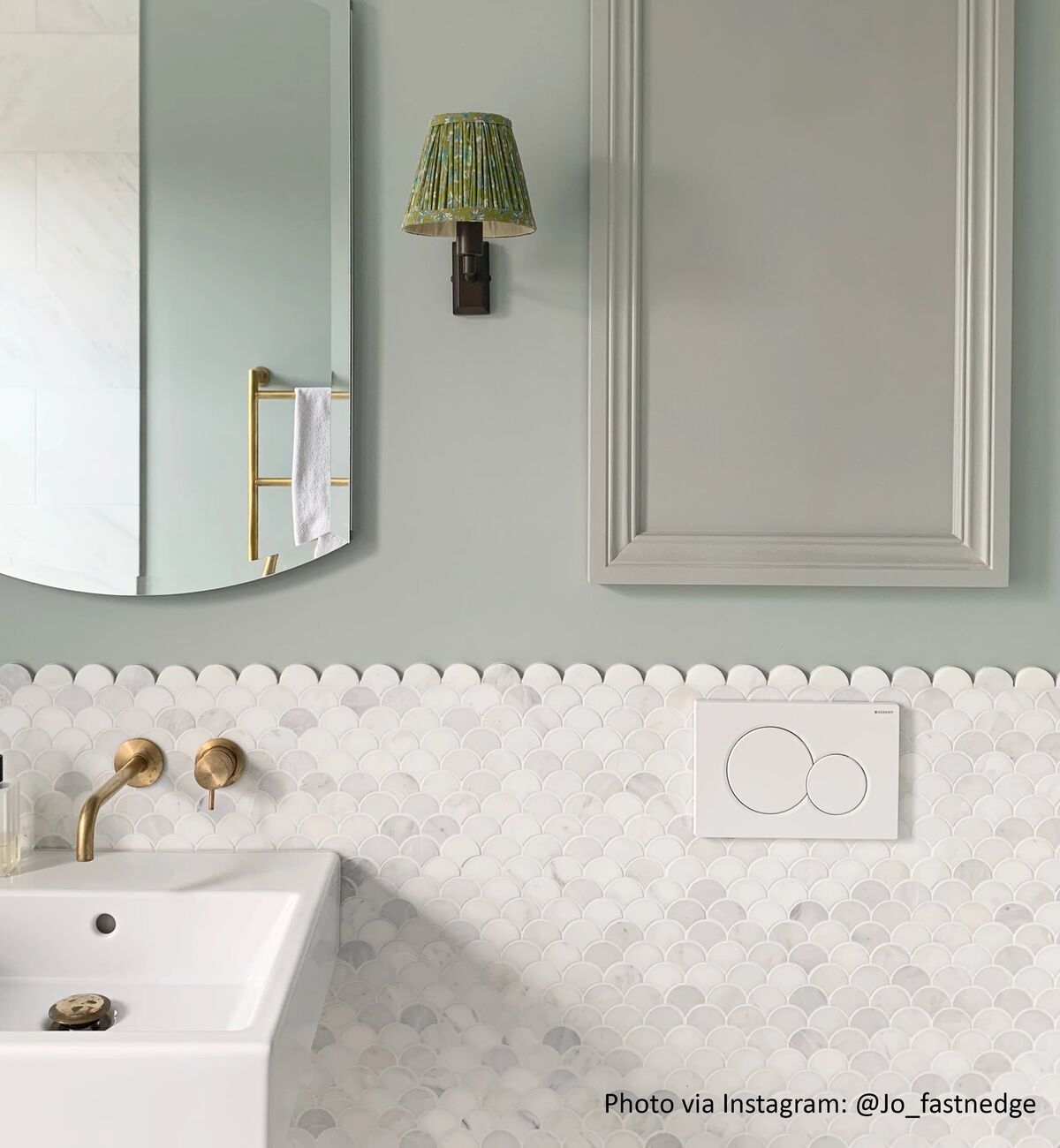
For large format tiles, a 3mm grout joint is the minimum. A joint at this width gives the surface room to accommodate minor expansion and allows a skilled tiler to achieve a truly even result. For rectified tiles with machine-cut edges, a consistent 3mm joint can read as almost seamless. For handmade or textural tiles, where slight variation in size is part of their character, a slightly wider joint tends to suit the material better.
Grout colour matters just as much as width:
With large format tiles, grout lines are few and widely spaced. Each one carries more visual consequence than it would in a smaller layout.

Does tile orientation change how the space feels when styling a bathroom?
Orientation is one of the most effective tools you have for shaping how a bathroom reads. And with large format tiles, the choice between portrait, landscape and square settings has a pronounced effect.
A rectangular tile laid horizontally draws the eye across a wall. It makes a narrow room feel wider. The same tile set vertically emphasises height, which can help in a bathroom where the ceiling feels low.
A square format, or a rectangular tile set at 45 degrees, creates a different rhythm. It anchors the eye rather than directing it. For larger, more simply proportioned bathrooms, a grid aligned with the room's architecture often reads with the most quiet authority.
Make the orientation decision as part of the layout plan. Not as an afterthought. The tile and the room need to work together.
How should you plan around fixtures and fittings when laying large format tiles in a bathroom?
The positioning of tiles relative to fixed elements, baths, vanity units, shower enclosures and WCs, is one of the most practical reasons layout planning matters more at this scale. With small tiles, a cut around a pipe or a toilet base is relatively inconspicuous. With a large format tile, the same cut can become a focal point if it falls awkwardly.
Identify these elements in the planning stage and adjust the tile layout to accommodate them tidily. It's worth the effort.
Shower walls deserve particular attention:
What should you know about structural and substrate requirements before choosing large format bathroom tiles?
Large format tiles are far less forgiving of an uneven substrate than smaller tiles. Because each tile spans more surface area, any dip or rise is magnified across a wider span. It shows at the tile edges as lippage, and if it's left uncorrected it can lead to cracking over time. Check the condition of the substrate before you specify.

The choice of adhesive matters too. Use a large format tile adhesive with low slip properties to stop tiles shifting during installation before the adhesive sets. On floors, self levelling compound is often needed to bring the surface to the flatness that large format tiles require to bed correctly. A skilled tiler will know when it's needed and will treat it as routine.
These aren't complications to worry about. They're simply details to plan for.
Is there anything else to consider about light and material when planning a large format tile for the bathroom?
Surface finish is worth thinking through carefully, because with large format tiles it becomes more apparent than you might expect. A polished surface reflects light generously. Beautiful in a well lit bathroom, less so under harsh overhead lighting. A matt or satin finish distributes light softly, giving the space a settled quality that tends to age well.
Natural stone tiles need an extra thought. Because each tile covers more surface, the veining and movement in the stone reads as longer, more continuous runs across the wall or floor. This can be striking when tiles are book matched, mirrored to continue the pattern across joints. But it does require care at the point of selection. View full slabs before you order, or ask us for a layout recommendation. It ensures the material performs as it should in the space you're creating.
Explore the Fired Earth Bathroom Tile Collection
Start with the tile you love, then plan the layout around it. That's the order that tends to work best. Browse our full collection and request a sample or speak to one of our experts to begin planning your bathroom with confidence. We've been sourcing and curating materials for over four decades. We know what works, and we're glad to help.